
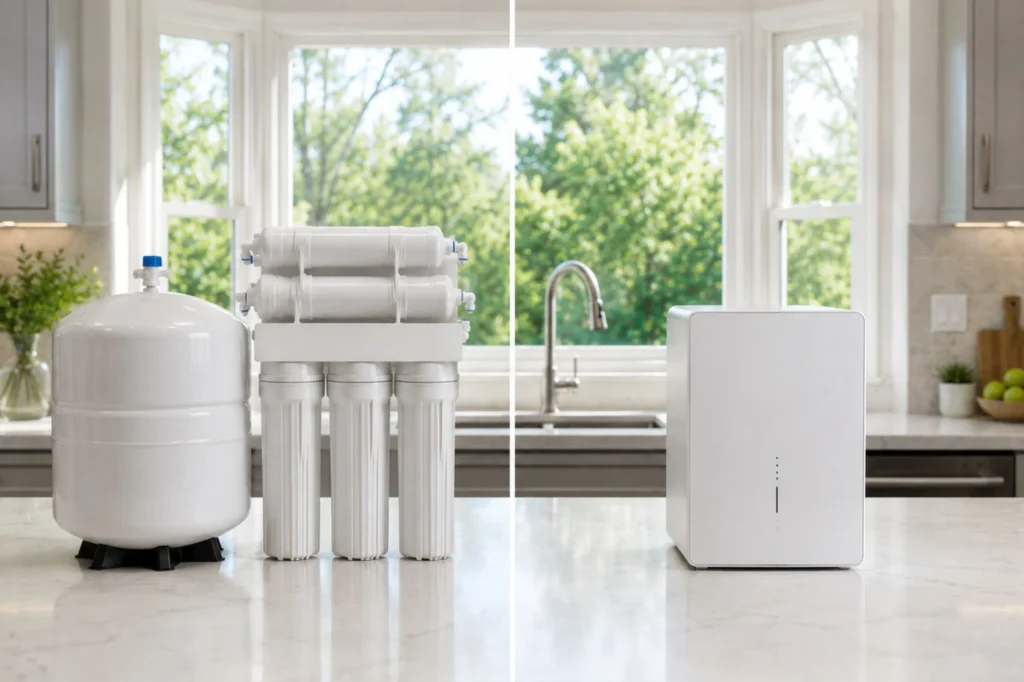
Take a look beneath your kitchen sink. Between cleaning products, plumbing connections, and miscellaneous household supplies, there’s probably not much room left. For homeowners interested in improving their drinking water, finding space for traditional filtration equipment can be surprisingly challenging. Fortunately, newer treatment designs offer an alternative that doesn’t necessarily require a bulky storage tank.
For families throughout Lancaster and Southeastern Pennsylvania, tankless reverse osmosis systems offer a convenient approach to drinking water filtration while making efficient use of available kitchen space.
These systems can be particularly appealing to households that value convenience, practical design, and better-tasting water. But before investing in one, it’s worth understanding how the technology works and what makes it different from conventional filtration equipment.
How Tankless Reverse Osmosis Works
Traditional reverse osmosis equipment typically produces treated water gradually and stores it inside a dedicated pressure tank. Whenever someone opens the drinking water faucet, that reserve becomes available.
Tankless equipment takes a different approach.
Water passes through filtration components and a semipermeable membrane when treatment is requested. Many models incorporate an electric booster pump to help achieve suitable operating pressure and production rates.
The membrane reduces many dissolved substances, while additional filtration stages help address suspended particles and certain unwanted tastes and odors.
Without a separate storage tank, the equipment can often occupy less cabinet space.
However, production rates vary between models and depend on operating conditions. Comparing actual performance specifications is important when selecting equipment for your household.
Freshly Filtered Water Whenever You Need It
Imagine preparing dinner while your children fill their water bottles for the following morning. Nobody particularly wants to wait for a traditional filtration tank to replenish after its stored water has been used.
Having on-demand filtered water available through a suitably sized tankless system can make these busy household moments considerably more convenient.
Whether you’re filling a cooking pot, preparing homemade lemonade, or making your morning coffee, treatment takes place as water is requested.
Of course, tankless doesn’t mean unlimited instantaneous flow. The equipment still has a maximum production rate, and filling larger containers may take longer than expected with certain models.
Choosing a system that accommodates your family’s consumption habits helps ensure that convenience remains one of its greatest advantages.
Understanding What Reverse Osmosis Can Remove
Water quality concerns differ between properties throughout Lancaster and Southeastern Pennsylvania. Some households experience unpleasant disinfectant tastes, while others have concerns about specific dissolved substances.
Appropriate RO drinking water treatment can reduce contaminants such as nitrate, lead, fluoride, and dissolved salts when the selected equipment has independently verified capabilities for those substances.
Additional carbon filtration may help improve taste and reduce certain unwanted chemicals.
However, reverse osmosis shouldn’t automatically be considered a complete solution for every water quality concern.
Private well owners may require additional treatment or disinfection depending on laboratory findings. Municipal water customers can review their supplier’s water quality reports before choosing equipment.
Reliable information makes selecting suitable filtration technology much easier.
Reclaiming Valuable Space Beneath Your Kitchen Sink
Not everyone has a spacious kitchen with generous storage cabinets. Older Lancaster homes, in particular, may have layouts where every available inch matters.
Eliminating a conventional storage tank can provide additional flexibility when organizing the area beneath your sink.
That extra room might accommodate cleaning supplies, household essentials, or items that previously cluttered your countertop.
Many tankless designs also feature integrated filtration components, creating a relatively streamlined installation.
Before purchasing equipment, check its dimensions and allow sufficient clearance for servicing. Many models also require access to an electrical outlet.
A compact system is only genuinely convenient when there’s enough room to install, operate, and maintain it comfortably.
Considering Water Efficiency and Operating Expenses
One question worth asking when comparing modern filtration equipment is how efficiently it uses incoming water.
Reverse osmosis produces a concentrate stream that carries rejected substances toward the drain. Different models have different recovery rates, so documented water efficiency deserves attention.
Some tankless designs may offer improved recovery compared with certain traditional systems, although this isn’t guaranteed simply because storage tanks have been eliminated.
Replacement cartridges, membrane costs, and electricity consumption should also be considered.
If your household regularly purchases bottled water, installing a dedicated filtration system may help reduce those expenses.
Rather than focusing exclusively on the initial purchase price, consider what the equipment will cost to operate and maintain over several years.
Keeping Maintenance Simple and Manageable
Modern filtration equipment can offer convenient features, including filter replacement indicators and automatic flushing functions. Nevertheless, regular maintenance remains essential.
Sediment cartridges accumulate particles, activated carbon eventually exhausts its treatment capacity, and membranes require periodic replacement.
Ask about replacement component availability and recommended servicing intervals before committing to a particular system.
It’s also sensible to investigate unexpected changes in water production, taste, or faucet flow.
Appropriate follow-up testing can help verify treatment performance, especially when addressing health-related contaminants.
A straightforward maintenance schedule helps preserve equipment performance without turning filtration into another demanding household responsibility.
A Practical Upgrade for Everyday Lancaster Living
For homeowners throughout Lancaster and Southeastern Pennsylvania, a tankless drinking water system can offer an appealing combination of space-saving design, convenient operation, and targeted filtration.
The benefits may become noticeable during ordinary moments — filling a reusable bottle before heading to work, preparing a family meal, or enjoying a refreshing glass of water after gardening.
Start with reliable water quality information, compare equipment thoughtfully, and choose a system that fits your household’s needs.
Not every kitchen improvement requires an expensive renovation. Sometimes, the smartest upgrades are hidden beneath the sink, quietly making everyday routines a little easier and more enjoyable.